Tuesday, February 16, 2016

Report from the CSA Farming Conference in Beijing!

This winter I didn't get to go on any tropical vacation, but I can't really complain because I got to go to.... China!  Yes, it was freezing in Beijing.  When we flew over the North Pole, the flight attendants served gelato, seriously.  I packed everything fleece and wool that I owned, and a respirator mask for the smog, and got onto a plane with a farming mentor and friend, Elizabeth Henderson.  The Chinese Government had helped sponsor our trip there, as guest speakers at the 6th International CSA Farming Conference! 
 We participated in a week of presentations and workshops, then a few days of visiting farms around the giant city of Beijing.
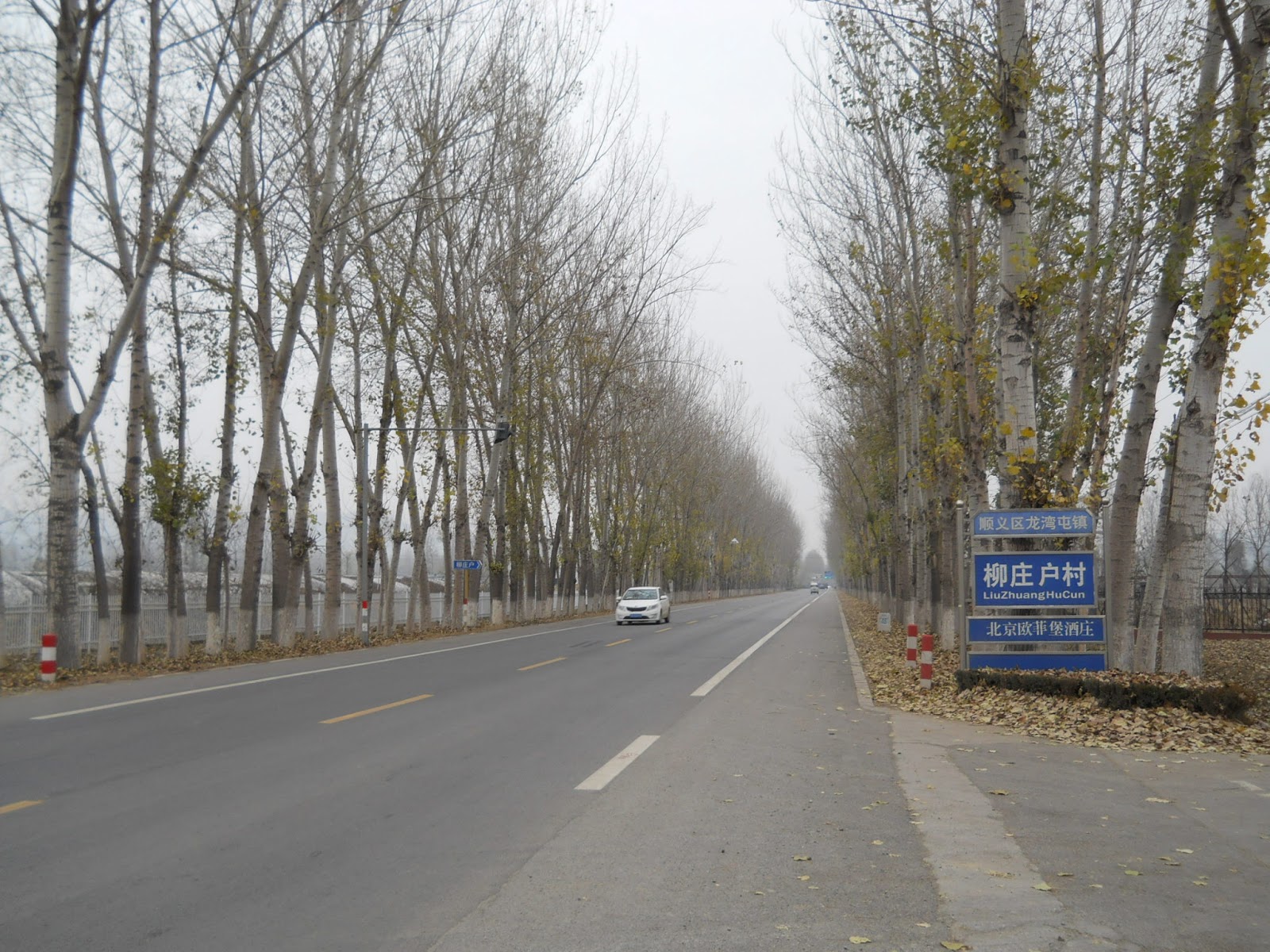
The air quality was indeed awful.  You could see how locals were somewhat forced to live in denial of it, feeling like they were powerless to change anything.
But we did see a hopeful amount of resilience.

Especially among the people at this conference.  There were over 800 people attending from countries all over the world, including a whole contingent from the Chinese National CSA Conference, which overlapped our international conference.   Most inspiring to see at this was the hordes of young Chinese farmers, officially dubbed the "New Farmer" movement.  These folks have usually gone to universities in cities, and choose to return to the villages where their families still have rights to some land.  This is a radical swimming-upstream, as much of what has been going on in China (and the world) is the mass migration of young people from their rural hometowns to large cities for work or education. 
In a touching display at the conference closing ceremony, each young farmer poured a bottle of their home farm soil into a big tube onstage!
 Elizabeth Henderson, my travel buddy, gave a great plenary speech one morning -- her book "Sharing the Harvest" has been translated into Chinese, and she is quite a celebrity there!
Did you know that CSA started in the 1970s in Japan, then spread to Europe and then to the US, and finally came back around to China just about 10 years ago?  There are CSA networks all around the world, on every continent.  We spent a lot of our time hanging out two farmers from West Africa, and a farmer friend from Long Island, Scott Chasky.
We also had an amazing interpreter who allowed us to learn and share with local Chinese farmers who didn't speak English. 
And we met some fun characters who did speak English -- Tammi is a butcher / pig farmer from Melbourne, Australia who makes her own charcuterie and has a meat CSA.
 Although the conference and the whole experience usually involved lots of translation, we learned that people care about the same things as us:  healthy soil, healthy farms, healthy communities.
 In China, they still have a strong "peasant" culture -- people who have been living in rural areas, subsisting off the land, usually using very "sustainable" and "organic" practices.  
This is the Chinese Yam, a staple food for locals.  The root is starchy, like potatoes but supposedly very healthy for you.  We had it almost every day, maybe almost every meal.  The root itself grows very deep, and all the farms we visited (small organic farms, granted) dug them by hand!
The Yam grows a long twisting vine up trellises, and has these tiny little "potato berries" that you can eat too!  Two crops in one!  They were delicious, about the size of peanuts, and tasted like buttery potatoes.  Why don't we grow this crop in the US?
 
We went to an inspiring organic cherry farm / cooperative on the outskirts near the mountains, where a motivated New Farmer has moved back to help take over her family's orchard and do some needed creative-marketing for the cooperative.
These farmers have started to use geese to clean up their apple orchard -- they reported much less pest pressure on the trees from the presence of the geese.  They cooked us one of these geese for lunch.
 
Here is one of her creative labels for the boxes that she ships cherries in to urban customers who order their using a cherry farm "app"!
One of the CSA farms we visited had the farm divided into two --  one area where they grew vegetables to pack into CSA shares and deliver to folks, another area where locals could get a cheaper CSA subscription, and grow their food themselves -- with land, seeds, tools, water, fencing, advice, provided!  Like a community garden but with more coaching.
And some people might not need the coaching, they might just be doing what they have always known how to do-- possibly displaced peasants living in the city who don't have any rights to land.  
We saw some areas where people had dug big root-cellar pits in their garden plots, stuffing cabbage in them & covering them up.
Chinese Cabbage is the other winter staple here.  I was told that back in the day it was the only fresh vegetable around in the winter.  Then the government started sponsoring all these greenhouses, which expanded the possibilities.  Many CSAs are able to go year-round now due to the intensive greenhouse culture.
The greenhouses we saw in this district of Beijing (Shunyi district) were unlike any I have seen in the US.  They have a thermal wall on the north side, and a half-greenhouse on the southern face.  They are several hundred feet long and 25' or so wide.  Some farms used heat in these greenhouses (burning coal for heat is quite common there) but mostly the sunny days would heat up the massive northern wall (about a meter thick!) and that would radiate heat through the night.  Every evening a long metal arm attached to a motor would roll a blanket down to keep the heat in.  In the morning, it would roll up again.
On the very coldest days, the blanket stayed covering them, while poor little tomato plants shivered in negative 14 degrees Celcius. (-6F)
Yes, I said tomatoes!  In late November!  They were also expecting strawberries in February.  We also saw greenhouses full of ripe eggplants and peppers.
 
We saw lots of trellised things -- besides the obvious beans, winter squash (looks like of like Red Kuri) trellised up, and cucumbers that looked like they might have suffered from the extreme cold we had while we were there.
And here is a way to get some free fertilizer as well as eggs to sell to CSA members -- when you have 20 greenhouses of the same size, you can easily work out a rotation where one greenhouse gets chickens.
The farm where we spent most of our time was Shared Harvest farm, the founder of which (Shi Yan is her name) worked at a CSA farm in the US before returning to her hometown and starting up something similar.  She got a lot of support from her local government, and hired a lot of young people to help with marketing and distribution, and hired some old pros (with their peasant wisdom) to manage the farming!  They employ 35 people and feed 600 families.
Can you believe, each of those 600 CSA members gets to custom-order their vegetables?
That's a lot of work.
They also delivered each of these boxes to everyone's doorsteps!
They had just made the switch to hiring a delivery company instead of doing it themselves.  When we asked why couldn't CSA members come to the farm to pick up their shares, they responded, "Chinese people work too much and don't have any time to go to a farm."  They are catering to the urban Beijing crowd which apparently demands convenience.
Personally, I do think that a very busy person who is working all the time misses some of the finer points in life... like smelling the earth where your food comes from.  It's a hard point to argue though, in today's society.
 This tofu is distributed to CSA members--- one afternoon we got to check out the tiny family business that is thriving due to Shared Harvest CSA.  They start with organic soybeans grown on a local farm, and grind them up.
Then, the mash is strained and heated in a giant cast iron vat, heated underneath by a fire made of corn cobs and coal, stoked by an old woman.
Then there is a process of cooking the soy milk, which we got to enjoy as a warming beverage while we were waiting for the curd to form.
The fire, by the way, not only heats the big cooking pot, but then heats underneath a bed in the adjacent room, where the family sleeps.  Peasant smarts.
Then the soy is poured into cheesecloth molds, pressed, and becomes tofu!
We had a lovely time, especially Elizabeth and her new lady friends.

One day I went to downtown Beijing to visit the new organic farmers market.  It is definitely ironic to be shopping for organic food when your air is so un-organic that you have to wear masks outside. 
But even with the unseasonable cold and the snow, dozens of dedicated farmers showed up to sell their goods.  There was also an indoor "Community Market" as part of this farmers market, which sold products from all the local farmers, and had a communal kitchen and gathering area.  This place was warm and welcoming, and definitely inspiring.  Could you imagine if we had these in all our US cities?
 Despite all the wonderful and hopeful things that we saw during this trip, there was still a looming sense of giant things that are just baz-ackwards.  They are on a scale beyond governments; big international phenomena.  The photos below are of slides presented by a Chinese university professor, cartoons about rural people becoming urban people, against their will.
 
Even though this phenomena looks different in the US, and we have incredible freedom and democracy, urbanization really does threaten us too.  When we take everyone off the farms so they can work/live/study in the city, where are we going to get our food?

We are forced to rely on low-labor, highly-mechanized factory farms that grow giant fields of mono-crops, and are more about business than about family and culture.  While this presents convenience for us urban folks, what have we lost by the wayside when we've abandoned the hard-working peasant life?

Maybe we can regain some of the richness of our ancestors' traditions, without completely going "back to the land" ... maybe being a CSA member or a CSA farmer can be a way to stay connected to both worlds.
Below was the final slide presented by Shinji Hashimoto, a CSA farmer in Japan, who shared heartbreaking stories of his friends who farm near the Fukushima nuclear disaster.  He speaks with hope, and with conviction for this movement.  Teikei is the original Japanese word for CSA.  Teikei in Japanese means "cooperation", "joint business", or "link-up".  It is commonly associated with the slogan "food with the farmer's face on it."
 I saw that people on the other side of the world are talking about the same things -- cooperation, a healthy place to live, good clean food, and a celebration of the rural values of hard work, savoring life and each other.


Sunday, May 10, 2015

Starting


We're turning a hay field into a vegetable farm on a non-profit horse ranch
In the past few weeks, we've:

1.  Borrowed a neighbor's plow


2.  Transported flats of plants that we've grown at the greenhouse


3. Prepared ground for planting (built a roller-marker for behind the tiller)


4.  Planted a quarter acre of lettuce, broccoli, cabbage, kale, onions, carrots, spinach, beets, herbs


5.  Set up a drip irrigation system


6.  Covered the brassica-family plants (cabbage, broccoli, kale) with row cover held down with lots of sandbags because it's a windy hill


 7.  Staked out a 3 acre deer fence and drilled holes with a rented bobcat and post-hole digger


8.  Received our donation of fencing material from a generous Home Depot grant


9.  Set post in ground with the help of strong Veterans and volunteers


10.  Put eight-foot-tall wire fencing up


11.  Put together a set of cultivating tools on my "new" antique Farmall Cub tractor ('53)


12.  Watched the world become filled with flowers and green things!


On your mark, get set, this summer is GO


Friday, April 24, 2015

Spring, the vital energy returns!


Winter succumbs her subtle beauty to the Spring,
with protest
 in the form of snowflakes.


Today, a week from May,
they lazily wandered through the greening landscape,
announcing their soft, pure, powerful presence of 
coziness and letting go

to the vibrating and insane pace of sap flow, insect emergence,
and frantic nest building.


We have been busy little seeders in the protected shell of the greenhouse.

And busy pruning blueberry bushes before the buds burst.


I have been so busy that I nearly forgot myself.

As things move from inside to outside in this transition,
I crawled out like an anxious awkward bug, unaware of all its appendages,
yet keeping its eyes on the prize and using age-old instinct
to navigate the challenges ahead.

I broke my toe on the stairs.  Twice, in the same darn place.

The body's wisdom
of slowing-down,
even with sacrifice,
for the greater balance of things.


My fruit trees arrived in the mail the same day I made an offer on a piece of land. 


I decided to start buying tractors and stuff again...


Spring, FINALLY.
Things that seemed dead asleep for ages and ages come crawling up in shades of vibrant green.
Miracles.  An eight-petaled bloom where snowflakes piled up three feet thick.


Then it happens, one evening, always when I'm not expecting it.
The urge to till the soil again.

To ask the gentle ground if she will bear us food
another year.

The silent sacrifice of earthworms to the plow,
the rich smell of warming soil,
what the steel and the diesel allow us...

Springtime creates strong instincts in animals, including human farmers.

To jump on the tractor and claim a piece of the land, in determined frenzy.


And now all those unromantic errands that go with farming,
like picking up new tractor tires from Waterloo,
clog up the never-ending TO-DO list.


While the dandelion's spring to-do list includes:
              1. LEAF
              2. BUD
              3. STEM
              4. FLOWER
              5. SEED
Among other tasks, such as vital mineral acquisition and transport up from the deep.


And, as human species with capable large brains, 
our To-Do list, this spring and beyond,

Maybe could include action on some long-term goals:

Like saving our toes, and our balance.
 Our barns, our farms, and our communities.
Our one precious planet.


James Hansen, top Climate Scientist, spoke a few days ago in Rochester, NY, 
and suggested his hope
for our future

Let's direct our vital energy this spring to what is truly important to us.
The time to wander like lazy snowflakes is over.


Bloom where you are planted, 
bloom strong, 
in the face of the frozen past and the uncertain future.


Sunday, April 5, 2015

Barn Razing


A barn builds community, as the community builds a barn.
Same applies for taking one down I would say.


Last week I went down to Groveland to lend a hand in the dismantling of a "small" barn which is ages old, and has been taken down and put back up who knows how many times.


This barn was taken down and put back up here by my friend Eli, who thought he was going to be farming in Groveland, and now finds himself moving to a well-established farm in Newark (Peacework Farm).  Funny how plans change.  I don't know anything about that!


Eli gifted the barn to Ruth to put up at Mud Creek Farm over in Victor, as long as she could... take it down and put it back up.  Of course, she is not going to do this by herself.  So about 15 of us pitched in for the day, in the ages old practice of coming together as a community so the job gets done and nobody gets hurt.


We dismantled the thing using a variety of techniques... a constructed A-frame & pulley system which I am still not actually sure how the thing worked... heavy-duty straps... ladders...supports...


...pounding out the wooden pegs that hold the whole thing together.


Lazy snowflakes fell silently and disappeared in the mud, and the blackbirds announced their territories around the pond.  I looked around and felt glad to have all these wonderful people in my community, young people who value things like old barns.


Finally the last wall remained.


We were going to take this wall down by the strength of our arms alone. 

Slowly, slowly, carefully, carefully.      Everyone ok?      Over there, over there!      Yeah, right there. 
Keep breathing.      Slowly.      Good.
 
A whole minute of extreme concentration, where every bird's syllable becomes crisp and clear, 
and you value things like 
the traction of boots and leather gloves, the muscles in everyone's arms, tall people.


Just to give you an idea of the weight of these beams, some of them took 10 people to lift.  
Serious oak, the kind they're not making anymore.

And we did it! 


Then we dismantled all the walls on the ground, pounding them apart where they fit together like lincoln-logs, each perfect little slot fitting neatly into the next beam.  How I admire those little hand-carved wooden pegs that miraculously hold a thing like a barn together. 

After the truck and trailer got stuck in the mud trying to get down to the barn, we decided we would have to haul them up the hill to the road.


We piled high the trailer that would take this barn to it's new home.


Nothing left here but a bit of clean-up, and the ghost of a dream that hardly started in this field.


Although he directed the day's progress with good spirit, I feel a bit of Eli's sadness in the going-away of his plans for this land.  At breaktime, we all marched through his piles of farm junk and timidly laid our claims.  A historic agrarian sight-- a bunch of dirt-covered people standing around in their boots, discussing the value of a grain drill.  Or a walk-in cooler if these folks are vegetable farmers.

Plans change.  Stuff gets swapped around.  I gave away all my farm junk for a trip around the universe of the heart.  It was worth it.  Now I get to buy stuff to farm with again.


There's always a chance to start anew, even after a disaster like winter.

And, I guess, nothing really ever stays the same, not even an ages old barn.

But what doesn't change is our will to grow, our will to be a part of something bigger, something lasting, to be part of a family of friends, to help things along when fifteen can do what one or two can't.


Saturday, March 28, 2015

Therapeutic Farming

Let the growing begin!

I've started my work at the EquiCenter in Honeoye Falls, NY, as Farm Manager of their newly developing program for Therapeutic Farming!  The EquiCenter currently offers horseback riding and other equestrian activities to people with disabilities, at-risk youth, Veterans, and their families.  They have 200 acres of beautiful fields and 25 beautiful horses!  It's the perfect situation for starting a food-growing project:  beautiful rolling landscapes of pasture and hay, tractors, tools, barns, a group of eager volunteers, and as much manure as we need!

The EquiCenter has been already working with Dr. Beverly Brown, a Horticultural Therapist and professor at Nazareth College, to develop a program at the EquiCenter using small raised-bed gardens.  Now they've hired me to help them go from "garden" to "farm," increasing their ability for healthy organic production of food to distribute to families in need and the communities they are already working with.


Nazareth College has generously donated use of their greenhouse until we've got our own.  It's a fancy high-tech glass greenhouse with automatic temperature and humidity control, and I've even set up automatic watering on our germinating seeds.  We're also growing vegetable and flower starts for the healing garden at Nazareth that the students help run, and I am speaking to classes about organic farming.  I run a weekly volunteer session, for folks to come out and learn how to start vegetables from seed.  Many people are coming out to lend a hand-- we are almost out of room in there!


How nice is it to smell the compost-rich earthy potting soil and get your hands in it?  After a cold snowy winter, this is a welcome activity for me, and I am already benefiting from the therapeutic elements of germinating seeds in unfrozen soil.  Another benefit is the focused meditative state that comes with concentrating on putting just one tiny seed in each cell of the plastic seedling trays.  I like to imagine the full head of lettuce that each seed will become.  What a miracle I get to participate in.  What a powerful act to help turn soil, water, sunlight, and a speck of a seed, into a big healthy salad for a family.


We have started some broccoli, kale, onions, flowers, and lettuce so far!  Someday the snow will finally melt and we can plant these in the ground.  My planting schedule says they will be ready at the end of April.  I hope the ground will be thawed and dry by then!  I will be leading regular volunteer days several times a week out at the EquiCenter Farm starting in May.  Email me if you want to help out:  ebullock at EquiCenterNY dot org.  All ages and abilities are welcome to participate.  Come be a part of the miracle.  The hungry world needs you.