Tuesday, July 15, 2008

organic no-till agriculture

Four Winds Farm Tour:
We do a lot of plowing & tilling of the soil, as most farmers do, but yesterday I visited Four Winds Farm which hasn't tilled their soil in 14 years! They just spread a lot of homemade compost on their soil to build organic matter & prevent weeds from emerging. Of course they have about 20 cows, who provide enough manure in the winter months in the barn to be the basis of their compost fertility. These beef cattle are Herefords:
The compost pile is turned/moved 3 times with the front loader, then aerated with this stationary manure spreader. Then it sits for about a year before it gets spread on the beds.
The beds are permanent. The tractor tires stay in the same place every year, so compaction never happens on the growing surface of the beds. Here is some kale, undersown about a month after transplanting with crimson clover, which will become a green mulch until the winter when it will be killed by frost. Then compost is spread right over it.
Check out these blueberries! Lots and lots of compost & mulch!
They are experimenting with this marigold variety bred especially to rid the soil of nematodes.
An interesting way to trellis peas... just pvc pipe and twine. Extensions are placed on the top as the peas grow higher than this.
A beautiful sunset as the almost-full moon rises over the fields.

Sunday, July 13, 2008

visitors & visiting

Well!  A whole week without blogging!  
Lots of things going on... 

1.  We gave a tour & talked about mechanical cultivation to about 40 apprentices from different farms,
2.  A bunch of farmers came out for another tour with the theme of integrated pest management, organized through the Cornell Cooperative Extension,
3.  A flock of 13-year-olds from a local summer camp showed up to pull carrots & weeds! 
4. A few of my good friends came to visit for a few days & helped out with the work...
Here's what our produce share looks like these days:
And I visited my hometown of Rochester, where I plan to start farming next year on my own!  One unexpected land offer looks like this:

Lots of exciting leads... now I have a lot of work to do!

1.  Find people who want to help me start this farm.
2. Find land with good soil, location, etc.
3. Create a business plan.
4. Infrastructure:  greenhouse, irrigation, etc.
5. Equipment needed:  tractor, tools, etc.
6. Find a place to live!
7. Networking & marketing & community-building...

Sunday, July 6, 2008

summer overflowing

What's going on today on the farm...  everything.  (L to R):
1. The winter squash has gone through several cultivations, but there are still purslane weeds growing... they get uprooted then reroot themselves with the rain.  We'll have to take the tractor through them again I think before they send out vines.
2. The melons & cucumbers are vining all over the place.  Standing at the far end of the field looking back at the barns you get the feeling that the vines want to swallow the whole place.
3. Did you know that potatoes make fruits?  This round green fruit you're looking at is not a tomato, but they are in the same family, Solanaceae.  

I love swiss chard.

The fields are beautiful, with rows of lettuce, beans, herbs, leeks, and tomatoes.

These butterhead lettuce are really as delicious as they look.  And I can't wait for the fennel harvest... roasted fennel is one of my favorite vegetable dishes I think.

...as well as roasted zucchini & eggplant.  This eggplant is only the size of a pear, so don't get too excited yet.  And there are teeny green beans, which will quickly get huge with all the rain.  Summer crops are almost here.

The flower garden, which I planted almost entirely by myself from seed, is approaching full bloom.  It is very satisfying to think about that!  The yarrow (white flowers below) is a perennial which I didn't plant.  The one on the right is a Rudbeckia, a black-eyed susan, but this variety has "white eyes" I guess!  It was started in the greenhouse & transplanted.  
The blue flowers are Bachelors Buttons, one of my favorite cut flowers.  The orange daisys are Calendula, an amazing flower with medicinal properties, and edible petals!  Enjoy some on your salad.  And the picture below-right is California Poppies!  I guess you can grow them in New York after all.  Right now they are all closed up for evening, but they will open their 4 big orange petals in the morning if there's sun!

Some of my plant experiments (L to R):  Okra (the young pods are tasty raw!), Cardoon (french relative of artichoke but you eat the stems), and Mullein (a medicinal flower)
I found a Sassafras tree!  I may try some Sassafras root tea soon.  You use the root bark from young saplings.  Also, the leaves are edible (taste like root beer) & the dried leaves are used in Cajun or Creole cooking in a dish called File or Gumbo.  I'll be experimenting with that for sure... apparently it thickens soups.
   
I also found several Bolete mushrooms growing under the pine trees.  Most Boletes are edible, but there are some varieties that aren't, so I didn't take my chances.  Maybe someone is familiar with local edible mushrooms that wants to identify these?

The Japanese Beetles are here in force.  They definitely have favorite plants, like this Rhubarb, Elderberry, & Basil, shown below.  We've set traps out with pheromone lures.  The damage is pretty extensive in some places.

The Colorado Potato Beetle has also struck:

These bright orange larvae are chomping away.  There doesn't seem to be too many around thankfully, just on a few plants here and there.  They sure are weird looking.

Friday, July 4, 2008

garlic harvest party!

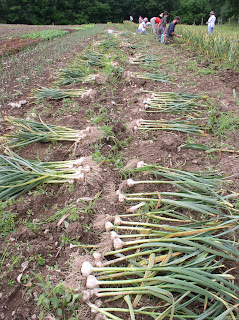
It was time for the garlic to come out of the ground, after growing there for 9 months.  Amazing how a small clove of garlic turns into a whole bulb in 9 months, with just water & fertile soil.  Oh, and lots of weeding too.  
Farmer Dave decided to take the tractor out with the chisel plow on it, to loosen up the bulbs so that they would come out easier.  
These curved blades ran right underneath the garlic, lifting them out slightly without damaging the bulbs at all.  Much easier than the way they had always done it before by hand, with digging forks.
Here's the little section we left with the garlic scapes still attached... they elongate & grow these little bulb-like flower heads, all pointed in the same direction, like little goose necks.  The bulbs they make underground are smaller, because the energy goes into the top part.
We had a great turnout of volunteers to help us harvest!  Here's some pictures:


Steps to harvesting garlic:
1. Loosen soil (chisel plow/ spading fork)
2. Pull garlic up
3. Rub palm of hand against the roots to remove soil that sticks to them
4. Clean up a little, remove the slimy brown leaf on the outside, etc.
5. Bunch in piles of 10
6. Tie with twine, just above where the leaves start on the stems
7. Hang in barn to dry
Farmer Dave says we maybe should have harvested it last week because of the wet weather we've been getting.  A few garlic plants broke off at the neck because the outer layers were starting to turn yellow & rot.  But not too many.  And since we cleaned them up a little & have a fan in the barn where they're drying, they will probably be fine.  We could use a little lower humidity in the air for the next week or two.  Too much to ask?
And here they are in the barn, hanging on nails on the walls...
...and on strings strung across the ceiling.  The smell in here is amazing.  I'm hungry.
-------------------
Friday's harvest-- we had awesome volunteers again!  We even had someone picking the extra lettuce in the field (it's all ready at once!) to donate to a local food bank.
And an extraordinary 5-year old farm-kid has helped us in the field for 2 days in a row now, all day!  We converse about the dietary preferences of japanese beetles versus cucumber beetles,or different styles of hoes, and he knows just as much as I do.  And we make up stories or songs sometimes too.  Great fun.